Childhood Adversity and
Chronic Pain in Adulthood
What Our Survey Found, and Why It Matters
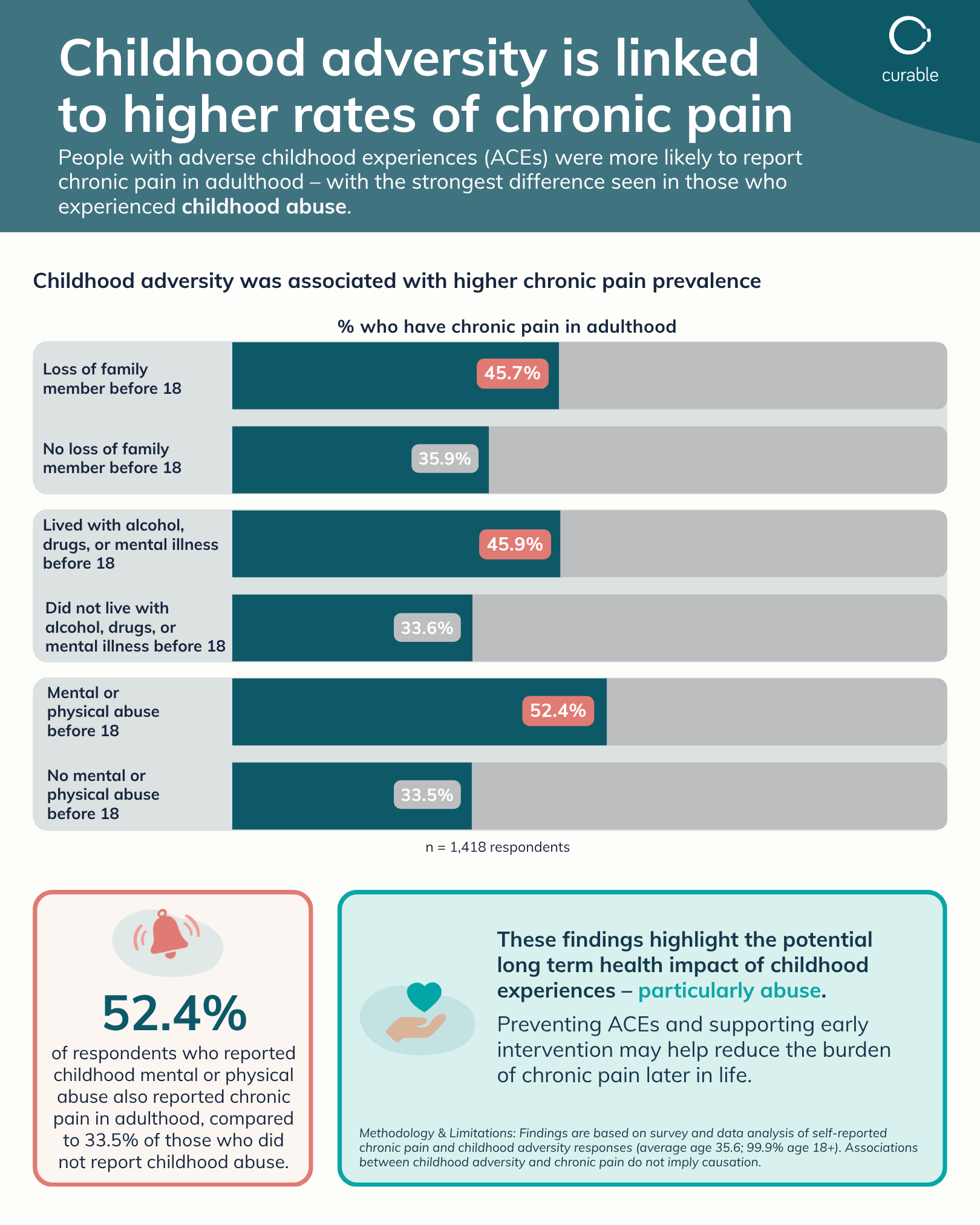
Tap here to download a printable version of this infographic.
If you live with chronic pain, you’ve probably heard some version of this story before:
- Stress can make symptoms worse
- The nervous system learns patterns
- The past can show up in the body
But there’s a big difference between a vague idea and something measurable.
In a survey we conducted with a broad global audience (1,418 participants, average age 35.6), we looked at three specific childhood adversity experiences and how they relate to whether someone reports chronic pain in adulthood.
What we found was consistent, statistically significant, and – in one category especially – striking.
What we asked
We used three yes/no questions about experiences before age 18, drawn from the same family of questions used in adverse childhood experiences (“ACEs”) research.
Specifically, we asked whether, prior to age 18, a respondent:
- Lost a biological parent or sibling through divorce, abandonment, death, imprisonment, or other reasons
- Lived with someone who was an alcoholic, depressed, mentally ill, or addicted to a drug
- Was mentally or physically abused as a child
These map to themes the original CDC–Kaiser Permanente ACE study helped establish in adult health research.
The headline finding: childhood adversity correlates with chronic pain in adulthood
Across all three childhood adversity types we measured, respondents who answered “Yes” to that adversity type were more likely to report chronic pain in adulthood.
1. Family loss before age 18
- 45.7% of respondents who reported family loss had chronic pain
- 35.9% of those who did not
Difference: +9.8 percentage points, statistically significant (p ≈ 0.0005)
2. Lived with alcohol/drugs or mental illness before 18
- 45.9% with this household exposure had chronic pain
- 33.6% without it
Difference: +12.3 percentage points, highly statistically significant (p ≈ 2.5e-06)
3. Childhood mental/physical abuse before age 18
This was the strongest single signal in the dataset.
- 52.4% of respondents who reported childhood abuse had chronic pain
- 33.5% of those who did not
Difference: +18.9 percentage points, extremely statistically significant (p ≈ 4.6e-11)
In short, in this sample, just over half of respondents who reported childhood abuse also reported chronic pain in adulthood.
A summary measure: any adversity vs. none
We also created a simple summary indicator:
- “Yes” if someone reported any of the three adversity experiences
- “No” if they reported none
In the data:
- 45.0% of respondents with any adversity reported chronic pain
- 30.0% of those with no adversity reported chronic pain
That’s a +15.0 percentage point gap, also highly statistically significant (p ≈ 1.2e-08).
Why the abuse finding stands out
In our three measures, the abuse item produced the largest gap in chronic pain prevalence:
- 52.4% chronic pain if abuse = yes
- 33.5% chronic pain if abuse = no
That doesn’t mean the other adversity categories are unimportant. They’re clearly associated too.
But abuse stands out because the difference is larger — and because abuse is a direct, person-targeted harm that can shape stress reactivity, threat perception, and mental health across the lifespan. It’s also often under-discussed in routine healthcare settings.
Clinically, this doesn’t mean every pain visit should become a trauma interview. But it does suggest something important for providers and systems:
Trauma-informed care isn’t a niche philosophy. It may be relevant to a meaningful share of adult chronic pain patients.
Another way to see the same story
Our infographic uses one consistent framing for clarity – “Among people with childhood adversity, what share had chronic pain?”
But to be confident this isn’t a quirk of how the question was sliced, we also examined the data in reverse:
“Among people with chronic pain, how many reported childhood adversity?”
That direction tells the same story.
1. Family loss before 18:
- Among respondents with chronic pain: 36.7% reported family loss
- Among respondents without chronic pain: 27.9%
Difference: +8.8 percentage points, p ≈ 0.00046
2. Household alcohol/drugs or mental illness before 18:
- Chronic pain Yes: 50.6%
- Chronic pain No: 37.9%
Difference: +12.7 percentage points, p ≈ 2.5e-06
3. Mental/physical abuse before 18:
- Chronic pain Yes: 38.3%
- Chronic pain No: 22.1%
Difference: +16.2 percentage points, p ≈ 4.6e-11
4. Any adversity:
- Chronic pain Yes: 69.0%
- Chronic pain No: 53.7%
Difference: +15.2 percentage points, p ≈ 1.2e-08
In other words, roughly 7 in 10 respondents with chronic pain reported at least one ACE, compared with about 5 in 10 of those without chronic pain.
The reverse direction confirms the pattern: chronic pain and childhood adversity track together regardless of which side of the comparison you start from.
That bidirectional consistency is one of the strongest signals statistically. Both framings agree.
How this fits with broader research
Our findings line up with a much larger body of public health research connecting adverse childhood experiences to adult health outcomes. The original ACE Study found that childhood adversity was associated with a range of adult health risks.
The point is not that adversity “explains” chronic pain. Pain is multifactorial: biology, injury, inflammation, genetics, environment, and access to care all play roles. But the broader evidence base – and our survey – suggests early adversity may belong in the conversation more often than it currently is.
What this does not mean
It’s worth pausing here because this topic is sensitive, and it’s easy for people to hear the wrong message.
Our data does not say:
- Childhood adversity “causes” chronic pain
- Chronic pain is psychological, or imagined, or someone’s fault
- If you “process your past” your pain will necessarily go away in the present
None of that is supported, and those framings can be harmful.
What our data does suggest is a more nuanced and more validating statement:
For many adults with chronic pain, early adversity may be part of their health story – and early adversity shows up at higher rates than in people without chronic pain.
That can be validating for patients who have long felt that their life history and health were treated as unrelated, or that their symptoms were reduced to “stress” in a dismissive way.
The goal is not to psychologize pain. It’s to widen the lens.
If you’re reading this with chronic pain
You’re not alone.
Many people spend years navigating a medical system that tends to look for a single structural explanation for chronic pain, and end up feeling dismissed when answers don’t come quickly. This finding is for you.
Your pain is real.
You’re not making it up.
Your history matters.
Our bodies keep score in many ways, and pain can be both biological and shaped by lived experience.